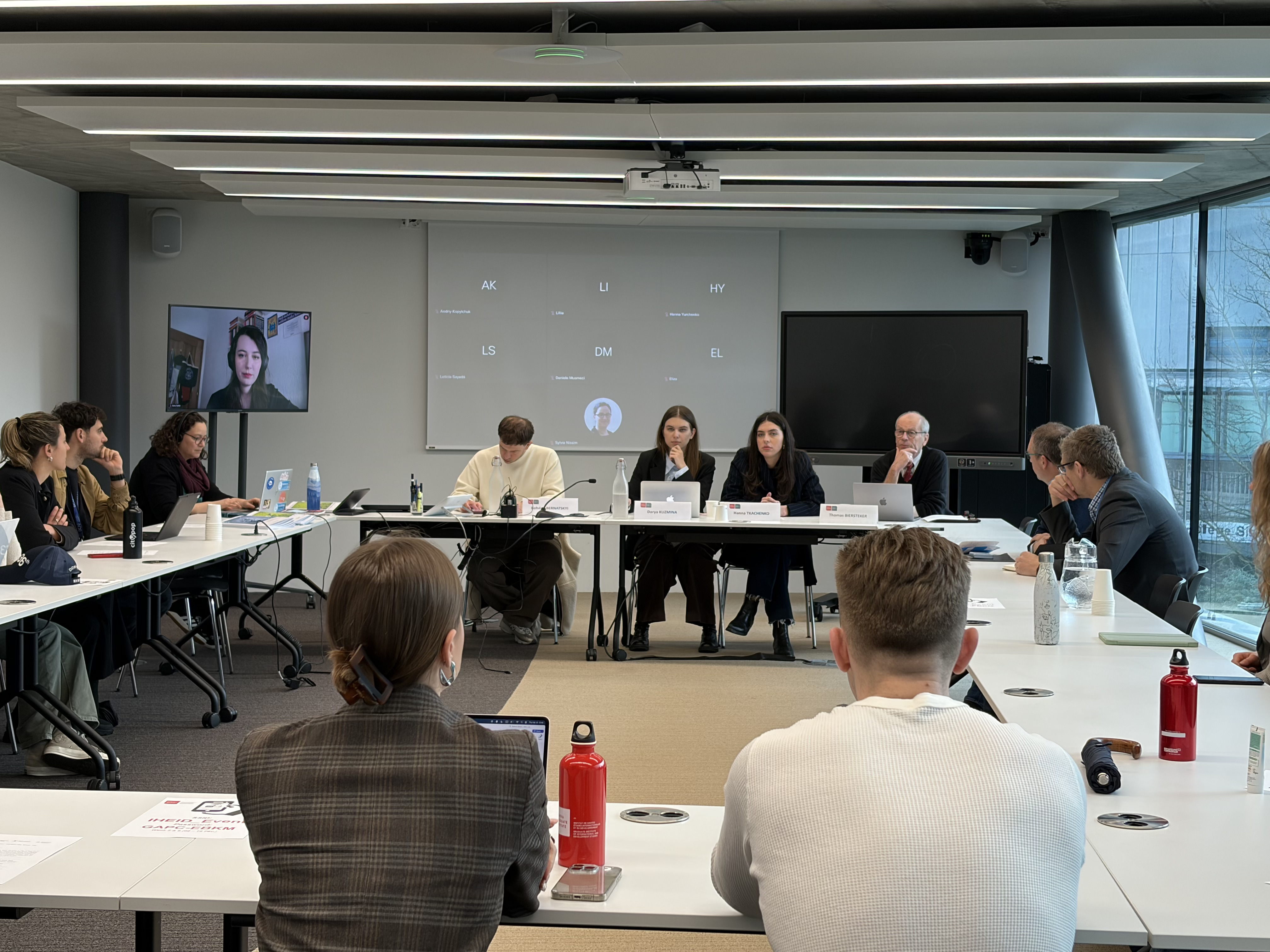
On 19 February 2026, an expert event of the Geneva International Sanctions Network (GISN) was held in Geneva under the title: “Third Countries and G7 Sanctions: Risks of Geoeconomic Fragmentation and Streamlining Sanctions Compliance.” The event was organized by the StateWatch think tank in cooperation with the Geneva Graduate Institute, with the participation of the Liberal Democratic League of Ukraine (LDLU).
Speakers included:
- Darya Kuzmina – Head of the Sanctions Department at StateWatch;
- Hanna Tkachenko – Policy Office Chief, Liberal Democratic League of Ukraine;
- Bohdan Bernatskyi – Research Fellow at Vilnius University and the European University Institute.
The discussion focused on the circumvention of sanctions against the Russian Federation through third-country jurisdictions. StateWatch analysts presented research findings on the re-export of Western technologies to Russia via intermediaries in Asia. In turn, Hanna Tkachenko outlined LDLU’s assessment of the role of the People’s Republic of China in Russia’s aggression against Ukraine.
In her remarks, Hanna Tkachenko stressed that Russia’s war against Ukraine has deep Asian roots, primarily linked to the role of the People's Republic of China. She referred to the 2024 Washington Summit Declaration of NATO, which identified the PRC as a decisive enabler of Russia’s war. In particular:
- 80-90% of the microelectronics found in Russian weapons originate from China;
- more than 76% of the machine tools used to manufacture Russian arms come from the PRC;
- total trade turnover between the PRC and the Russian Federation since 2022 has exceeded USD 900 billion.
LDLU maintains that a sanctions policy directed exclusively at the Russian Federation cannot achieve its strategic objective without simultaneous pressure on Chinese technological, energy, and defense-industrial conglomerates. This is due to the “anti-sanctions black hole” formed under Xi Jinping’s leadership, which neutralizes restrictive measures and enables Russia’s military-industrial complex to adapt to conditions of isolation.
Special attention was also devoted to the role of the Democratic People's Republic of Korea, which, according to LDLU’s assessment, is evolving into a “black jurisdiction” shielded by a nuclear and strategic symbiosis between the PRC and the Russian Federation. This includes the transfer of missiles, drones, ammunition, and the deployment of DPRK personnel to participate in the war against Ukraine. In this context, the UN sanctions regime has been effectively dismantled due to the arbitrariness of the PRC and Russia, while the effectiveness of traditional pressure mechanisms has been significantly constrained.
To reinforce sanctions pressure, LDLU proposed several practical steps:
- Include Ukraine in the Multilateral Sanctions Monitoring Team (MSMT) to strengthen efforts against sanctions evasion related to the DPRK;
- Establish a multilateral monitoring mechanism in support of Ukraine involving leading technological democracies – Japan, South Korea, Taiwan, the United States, and the Netherlands;
- Introduce secondary sanctions against Chinese companies involved in supporting Russia’s military-industrial complex;
- Strengthen coordination with customs authorities across the Indo-Pacific region;
- Accelerate the strategic diversification of supply chains as a foundational element of global economic security.
Russia’s war, launched in 2014 and escalated in 2022 with the strategic backing of the Chinese leadership, has created a new architecture of global insecurity. The Euro-Atlantic and Indo-Pacific regions are no longer isolated systems — they constitute a single security nexus. In this environment, economic security becomes the first line of defense in the 21st century. Diversification of supply chains, expanded sanctions and tariff pressure on autocracies, and support for strategic decoupling from the PRC represent a means of preventing Russia’s war in Ukraine from escalating into a broader multinational global conflict.
The Liberal Democratic League of Ukraine will continue its international advocacy for strengthening sanctions policy against the Russian Federation, the People’s Republic of China, and their allies in order to uphold national security and defend the rules-based international order.